


“It starts with blood”
A review of Kat Dunn’s lesbian vampire novel, Hungerstone
- by Jack Chandler
Entertainment Writer
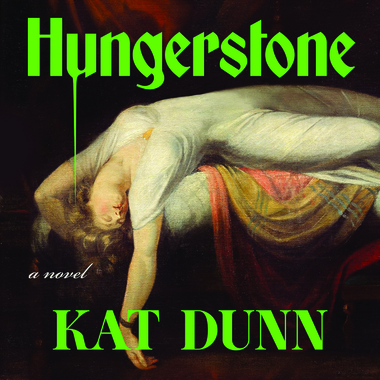
I picked Kat Dunn’s Hungerstone for its cover—at least, that’s what earned it a spot in the Final Three for my maiden voyage into sapphic literature.
What truly launched the ship, though, was seeing it (the book, not the ship) described as “a compulsive feminist reworking of Carmilla, the queer novella that inspired Dracula.”
Lesbian vampires? You won’t hear me declare I wanted to “sink my teeth” into it, but I will tell you, I clutched my pearls in glee—and was hooked—but not for the reasons you might expect.
Here’s Lady Lenore Crowther, as we meet her on the opening page:
“It starts with blood.
“In the middle of the night, I wake, like a hound scenting the fox, and place a hand between my thighs. It comes away sticky and dark.
“I used to feel grief about it, once. Now, I am numb—a task my body gives me to dispense with.
“Leaving a bloody splatter against the porcelain, I push the lid on the chamber pot and leave it beneath the bed. This was no quiet loss; I have not lain with Henry in many months. There was no hope to lose.”
Thus begins this very Gothic tale, set in 1888—late Victorian England, when the world’s most powerful queen presided over an empire where women were treated as little more than breeding stock trussed up in fussy dresses and ridiculous hats.
It’s a visceral, intriguing opening—and it sets the tone for the novel Dunn is actually writing, not the vampire romp the marketing promises. Dunn will return to this theme often: a woman’s fraught relationship with her own body.
The story unfolds at Nethershaw, an ancient, crumbling estate on the Yorkshire moors. One rainy night, as Henry and Lenore travel toward their new home, they encounter a wrecked carriage with a single occupant—the mysterious Carmilla, who must (of course) recuperate under their roof. Cue Cora, Lenore’s vapid “best friend” from London, who decides to pay an extended visit of her own.
That’s the setup: four people in a giant house, one of them the tamest, most de-fanged vampire I’ve ever encountered—more feminist spirit guide than anything else. This being a Gothic novel, there have to be a few secrets to unravel. Is Cora really Lenore’s friend, or Henry’s? Who’s trying to poison Lenore? (Hint: not the butcher, baker, or candlestick maker.)
Just to make sure everyone’s up to speed here, we have:
- A vampire story with no fangs.
- A lesbian story with a single, tepid sex scene.
- An arsenic and old lace mystery that requires no detective work to solve.
What captivated me was Dunn’s portrayal of Lenore — not as a Gothic ornament, but as a woman trapped in a world that treats her like one, just another piece of bric-a-brac wedged among the curios and clutter Victorians loved to cram into a room.
Since the entire novel is told from Lenore’s point of view, we see and feel only what she does. If her husband goes into his study and has a hushed conversation with another character, the absence of knowledge about that conversation looms large in Lenore’s mind.
Many authors would find a way to insert some bit of the “hushed” information back into the story. Not Dunn, and in doing so, she recreates the stifling world of a Victorian lady, where social norms wrapped her in those layered dresses and top-heavy hats and told her to mind her own business.
The sensual beauty of Hungerstone is watching Lenore’s intelligent mind blossom into confidence and agency. It is a slow, one-leaf-at-a-time unfurling, and, while the final feminist flower is glorious to behold, I came away with the feeling that the book was a lot of foreplay with no fireworks at the end.