


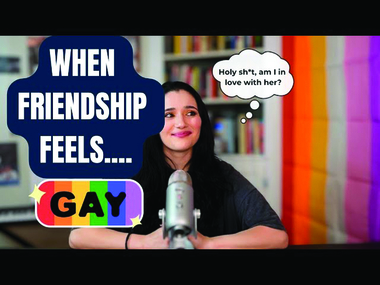
Every lesbian’s first elective: Homoerotic Friendship 101
- by Adèle Marie-Alix
Lesbian Columnist
The first time a woman used me as a vessel to test her own sexuality, it felt like being set on fire by someone who insisted they were only lighting a candle.
She touched me with curiosity, spoke to me with longing, and then recoiled as if desire itself were a wild animal she had accidentally invited indoors. Somewhere inside that contradiction, a pattern emerged that would repeat itself with my female friends over the years.
It was neither the characteristics of conventional romantic heartbreak nor a standard friendship fallout.
It felt more like I was a soldier drafted into someone else’s war of self-discovery against my will.
You will not find a clinical term for this experience, although every lesbian I know could diagnose it in mere milliseconds. It is the moment a friendship becomes a pressure chamber, where affection, admiration, and yearning blend until you cannot tell which is which.
Among the lesbian community, we refer to this as “Our Average Tuesday,” but the joke only functions because the truth hides within it. These elusive, illicit affairs are as serious as death.
“Homoerotic friendship” is the internet’s attempt to package this crucial phenomenon neatly, but the phrase excludes something quintessential. The longing is more than erotic.
It is epistemological.
It is the way queer women study each other to understand themselves.
A look becomes a hypothesis. A compliment becomes data. A lingering touch becomes the possibility of an alternate life, one where desire is allowed to speak plainly.
Many queer women grow up without a blueprint for desire, only a series of glances, crushes, and near-misses that feel too big to ignore and too unfamiliar to name. Friendship becomes the stage where those unnamed urges play out.
The ambiguity is what makes the dynamic so disorienting. The signals are legitimate, but the intentions are not always determinable. Two queer women can generate enough emotional voltage to power a small city, and still walk away, insisting nothing happened.
These blurred lines are not an accident. They are a coping mechanism and a tool. As long as plausible deniability is present, one or both women can go on pretending the spark was a trick of the light. The life they have crafted within a heteronormative society can remain unsinged.
Despite the detrimental nature of these friendships, there is beauty in them too, something that gets lost when we flatten the experience into jokes or tropes. While this phenomenon has scorched many a lesbian, it burns in a way that feels strangely formative. It teaches us how to decode our own yearning and is one of the few liminal spaces where queer women learn to authentically witness one another.
Homoerotic friendship is a rite of passage, yes.
But more importantly, it is a curriculum.
Most of us pass the course by the skin of our teeth, carrying with us a complicated mixture of wounds and wisdom, as well as a profound grief for the girl “friends” we lost.
Girls who, perhaps, braided our hair, taught us to kiss, held us at sleepovers, and lifted us up when we were down.
Girls who embellished the girlhood we had.
While most of these women are no longer in my life, they were necessary tutors whose lessons were invaluable. Though we may be apart, they made me unmistakably, irrevocably, the dyke I am today.
The Gayly online. 01/06/26 @ 12:46 p.m. CST.