


The fatal fantasy of lesbian innocence
- Adèle Marie-Alix
Lesbian Columnist
Going to the police is already an ordeal any average woman would rather swallow nails than submit herself to.
You sit there, picking at your nailbeds, harsh fluorescents beating down upon you, while a pit lodges itself in your stomach.
Not only is there the inherent fear of not being believed, but there is the mortifying exposure of admitting out loud that yes, this happened to me, and yes, I stayed longer than I should have.
And then, in its dreadful finality, the quiet, poisonous whisper: to some degree, I let it.
The embarrassment of recounting my story multiplied when I had to correct the officers taking down my statement repeatedly.
“So, your boyfriend—”
“Girlfriend.”
Because how could a woman possibly abuse another woman, right?
This question still manages to fry the collective circuitry, but its mythology is not maintained by the police alone— it is pervasive in lesbian spaces, too.
When I first dipped my toe into the sapphic pool, I discovered a doctrine that many newly minted dykes took comfort in: now that we were with women, no one could ever harm us again.
Men, after all, are the scum of the earth, the bane of society, and yes, they are frequently the abusers. Even outside the lesbian sphere, straight women often echo similar sentiments: “Ugh, I wish I were gay. Men are so awful.”
I fell for the rhetoric that lesbian love is automatically healthier, easier, and purer, because women are inherently nurturing, soft, and emotionally fluent creatures.
There is a deeply patriarchal fantasy embedded in how we discuss lesbian relationships: that femininity is synonymous with docility, and shared marginalization automatically produces shared ethics.
It does not.
Female abusers benefit from the cultural assumption that abuse must look a certain way: physical, obvious, and male.
In a lesbian relationship, abuse can be harder to detect, because it may center on emotional manipulation, control, or coercion— forms of harm that people already struggle to see the validity of when committed by men. No wonder there is widespread disbelief that physical abuse could occur between two women. Layer on the fact that lesbians are uniquely concerned with protecting the image of our community, and the “belief” problem becomes tenfold.
When abuse isn’t clear-cut, people rush to minimize it or neutralize it in the service of a comforting narrative. The aftermath is labeled “mutual,” “messy,” or simply reduced to a “toxic relationship.”
Unfortunately, neutrality protects no one except the person doing harm.
Perhaps it shields the disbeliever momentarily, but if the goal is to sustain and strengthen a marginalized community, ignoring abuse ultimately erodes both the safety and the credibility of that community in the long run.
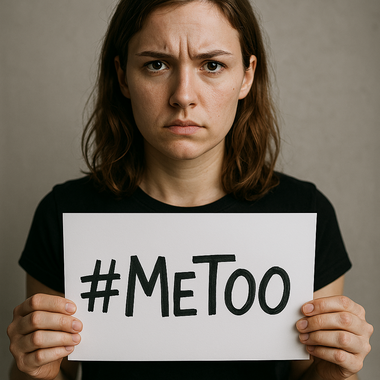
In a post-#MeToo world, misinformation surrounding abuse by women is rampant, and as a result, survivors of female abusers are rarely taken seriously. High-profile cases like the Amber Heard trial fueled widespread skepticism toward female victims. The smear campaigns against so-called “imperfect” victims like Heard shut down the chances of countless women being believed.
It is crucial to note that Amber Heard is a queer woman. Due to our position in society, abused dykes are not, and will never be, “perfect victims”.
Still, “Believe Women” was a necessary corrective to a culture that routinely dismissed, mocked, and punished survivors. I lived by it. Many of us did. For seemingly the first time, women’s pain was not something to be debated as a thought experiment.
But what happens when there are two women in the equation?
What happens when both walk away claiming victimhood?
These are questions we rarely want to sit with, because doing so requires discernment. And discernment is harder to digest than slogans.
These days, I know my truth: I am a lesbian, and a feminine woman emotionally, sexually, and once, physically, abused me.
Some chose to believe my story.
Others did not.
Some intervened and helped me escape a dangerous situation.
Others remained neutral.
I learned the hard way that abuse is not about masculinity. It is about power, entitlement, and control. Women are just as capable of these harmful behaviors as anyone else. To deny a woman’s ability to possess these traits is, in many ways, to diminish women as a whole.
If women can be anything— as Barbie feminism insists— then certainly they can be abusers.
I long for a lesbian community that helps push the world down the path of progress, as we have done countless times throughout history.
Lesbians are misunderstood, mischaracterized members of society.
We should make it our duty to embrace the difficult work of nuance.
With commitment and conviction, other lesbians like me may never have to sit under those fluorescent lights, hoping to be believed.
The Gayly online. 2/15/2026 @ 12:52 p.m. CST.