


It’s easy to sing about acceptance. It’s a lot harder to make it happen
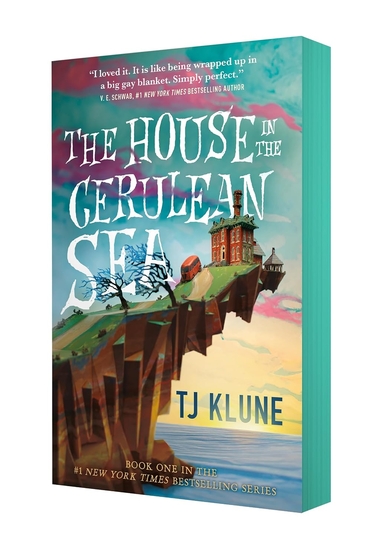
Read “The House in the Cerulean Sea”
- by Jack Chandler
Entertainment Writer
The House in the Cerulean Sea irritated the crap out of me and yet made me cry at the end.
Disclosure: I am not a fan of fantasy. I barely finished The Hobbit. I find it easier to accept science fiction’s alien worlds and creatures than an alternate Earth where humans and mythical beings (gnomes, sprites, yetis, and even phoenixes) coexist.
I’d heard the book described as “being like wrapped up in a big gay blanket.” Plus, it has more than 94,000 Amazon ratings and averages 4.6 stars. I decided to give it a chance.
In case you’re wondering, the fantasy part isn’t what irritated me, but I’ll circle back to what did. The same thing that got under my skin is what also made me cry—which is why I still recommend the book.
Linus Baker is a forty-year-old cog in the sprawling bureaucracy of the Department in Charge of Magical Youth, known henceforth as DICOMY.
Yes, magical youth.
In this world, DICOMY’s mission is to find these kids and herd them into orphanages. Linus is a caseworker, tasked with inspecting these homes to ensure the children are properly cared for.
One day, Linus is summoned to a meeting with Extremely Upper Management. They task him with a month-long inspection of the top-secret Marsyas Island Orphanage, where the most alarming children are housed. He’s to recommend whether Arthur Parnassus should remain in charge of that orphanage or whether its children should be sent elsewhere.
The children at this place are delightful—as diverse as the colors on a rainbow flag—but six-year-old Lucy (short for Lucifer) stole my heart. His file describes him as the Antichrist. He has extraordinary powers, plus the imagination you’d expect of such a child. Picture meeting a scrawny kid with fledgling horns and red eyes, saying in a squeaky voice that he’s going to melt your organs, then asking if you’ll read him a bedtime story.
In other words, he’s your typical boy: annoying, questionably hygienic—and essentially harmless.
Here’s what irritated me: there’s a kumbaya feeling going on here. There’s minimal worldbuilding. I wanted to know whether magical youth emerge from these orphanages and enter the larger world. I wanted to see a gritty, believable struggle as humans interact with these “others,” who obviously represent marginalized people.
Instead, I got the equivalent of stoned hippies playing guitars and singing folk songs. It’s easy to practice radical love and acceptance on a tiny island protected by a sprite and a phoenix. What happens when six-year-old Lucy turns eighteen?
It seemed to me like DICOMY itself was the main antagonist and the larger world got a pass—as if bureaucracy is the problem and we queers should just trust the better natures of our MAGA neighbors.
Yeah, that rubbed me wrong. It’s easy to sing about acceptance. It’s a lot harder to make it happen. (I live in Oklahoma. The only thing protecting the sanctity of my marriage to a man isn’t the kindness of my neighbors. It’s the Obergefell ruling.)
And here’s what made me cry: that kumbaya feeling going on here. I wanted to join in, sit cross-legged, take a toke, and be a part of a world where Lucys and bearded girl gnomes are accepted for who they are and not what they seem.
What follows is a poem written by Sal, one of the children, clacking away at his typewriter. What follows here is what made me cry.
I am but paper. Brittle and thin. I am held up to the sun, and it shines right through me. I get written on, and I can never be used again. These scratches are a history. They’re a story. They tell things for others to read, but they only see the words, and not what the words are written upon.
I am but paper, and though there are many like me, none are exactly the same. I am parched parchment. I have lines. I have holes. Get me wet, and I melt. Light me on fire, and I burn.
I am but paper, brittle and thin.
Sniffle.
(Thank you, Lucy P.—Lucy-Lu to me, our goose since 9/11/99—for putting this book in my hands.)
The Gayly online. 10/20/26 @ 6:49 p.m. CST.