


Venezuela: From survival to recovery
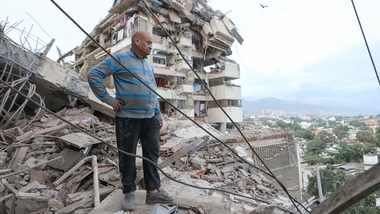
University of Miami experts assess humanitarian and medical response after Venezuela’s devastating twin earthquakes and the rarity of a “doublet.”
- by Robert C. Jones Jr.
For Newswise
Dr. Zeina Hannoush felt the ground shake beneath her feet and steadied herself.
Throughout her childhood and early adulthood in the Venezuelan capital of Caracas, she had never experienced an earthquake. But when the first of two violent temblors began to devastate parts of the city of her birth last Wednesday, she knew precisely what was happening.
It was just after 6 p.m., and the University of Miami Miller School of Medicine physician had walked only a few steps away from the home of an aunt and uncle she had just visited.
“I drove the 15 minutes to the part of the city where other members of the family were staying,” said Hannoush, speaking from her in-law’s home in Caracas, where she and her children are staying while visiting relatives for the summer. “I was fortunate. The neighborhoods I drove through didn’t suffer extensive damage- hardly any.”
That wasn’t the case for other areas. The two earthquakes—a magnitude 7.2 foreshock followed just 39 seconds later by a larger 7.5 mainshock—hit La Guaira, the coastal state near Caracas, the hardest, toppling buildings, killing hundreds of people, and trapping many more beneath rubble.
“Many of the people I know are still trying to locate their loved ones,” said Hannoush, an associate professor of clinical medicine who attended medical school in Venezuela. “They have not been able to communicate with them. So, there’s still much we don’t know about the loss of human life.”
As of Friday, the death toll sits at 589 people, with more than 3,000 injured. But thousands more are feared dead.
Search and rescue
Emergency response teams within the country have mobilized, and aid from other countries is pouring in. The U.S. State Department has pledged its support by deploying search-and-rescue teams from Fairfax County, Virginia, and Los Angeles, Secretary of State and School of Law alumnus Marco Rubio said.
In the immediate aftermath of the back-to-back earthquakes, Venezuela will face daunting challenges, with medical care for the injured as the most important priority, according to Dr. Elizabeth Greig, assistant professor of medicine and codirector of the Global Institute for Community Health and Development at the Miller School, a humanitarian and disaster relief program.
“Venezuela’s been hit by two massive earthquakes in dense, concentrated urban areas. So, when there’s a scenario such as that, there will always be a prolonged search and rescue effort,” Greig said. “Earthquakes generate a lot of injuries that require high-level surgical attention—fractures, crush injuries that will require surgical intervention. So, the first few days are just about search and rescue, assessing the damage, getting people safe, getting people medical care, and increasing the amount of medical aid on the ground just because of the nature of what an earthquake disaster entails.”
As a result of the disaster, many residents are now suddenly homeless and will be living in areas with no running water and poor sanitation, exacerbating medical conditions they may already have, she pointed out.
“Disasters don’t occur in isolation,” said Greig, who, as a fourth-year Miller School medical student, helped care for patients and coordinated the logistics of the Global Institute/Project Medishare’s 240-bed field hospital in Haiti in the aftermath of the earthquake that struck that island nation in 2010. “You still have your routine, day-to-day health conditions, and other medical emergencies to deal with”
The Global Institute is now examining the types of aid it could provide to Venezuela, with telehealth services among the possibilities, according to Greig.
Earthquake ‘doublet’
As for the science behind the temblors, the two powerful earthquakes that struck Venezuela’s northern coast were part of a seismic doublet sequence—two earthquakes of similar magnitude that occur close in time and proximity —which likely indicates a complex rupture-interaction process, according to the U.S. Geological Survey.
“It is unusual, but not impossible,” Guoqing Lin, a professor of geophysics and associate dean of research at the Rosenstiel School of Marine, Atmospheric, and Earth Science, said of doublet events. “Aftershocks often follow large earthquakes, but having two very large earthquakes occur within such a short time window is much less common. In this case, the first event may have rapidly changed the stress on a nearby part of the fault system and helped trigger the second, larger rupture.”
As more seismic data are analyzed, she noted, scientists may refine their interpretation of Wednesday’s catastrophe, determining whether it was best described as two distinct earthquakes or as one complex, multistage rupture.
Tremors were reported across northern Central America, which isn’t unusual, according to Lin. “A large earthquake can be felt over a very wide region, especially through long-period seismic waves,” she explained. “But the strongest ground motion usually occurs closest to the rupture. In this case, Venezuela was much closer to the source and experienced much stronger shaking.”
The deadly twin temblors struck more than two weeks after a magnitude 6.1 earthquake hit off the northwest coast of Cuba, triggering shaking that was even felt in South Florida.
Could the two events be related? “Very unlikely,” Lin said.
“They both occurred within the broader Caribbean tectonic region, but on different parts of the plate-boundary system,” she said. “The Cuba earthquake occurred near the boundary between the North American plate and the Caribbean plate, while the Venezuela earthquake occurred along the southern Caribbean boundary, where the Caribbean plate interacts with the South American plate,” she said.
“Any stress change from the Cuba earthquake at the Venezuela source region would be expected to be very small,” Lin added. “The Venezuela earthquake is much more likely to reflect accumulated tectonic strain along the Caribbean-South American plate boundary.”
Hope and recovery
For Dr. Lilian Abbo, a professor of clinical infectious diseases at the Miller School, the earthquakes brought back unpleasant memories of December 1999, when torrential rains caused massive flooding and landslides in La Guaira, killing thousands.
Back then, she had just graduated from medical school in Caracas when the floods occurred, and she volunteered to help, flying to affected regions to provide medical care to victims. “The images we’ve been seeing of collapsed buildings and flattened roads caused by the earthquakes have reminded me so much of the suffering that occurred in La Guaira 27 years ago,” said Abbo, who was born in Philadelphia but moved to the South American country with her Venezuelan-born parents when she was 3 months old.
What made Wednesday’s one-two punch especially difficult is that it occurred on the Battle of Carabobo Day, a major holiday in Venezuela that commemorates a decisive 1821 military victory that secured the country’s independence from the Spanish Empire.
“Many people, rather than being at work, were at home with their kids. Many of them were watching the World Cup. Many were in shopping malls,” said Abbo, stressing that extensive aid is needed not only for earthquake victims in the capital city but in surrounding areas that may be harder to reach.
Dr. Daniela Galan, an assistant professor of clinical radiology at the Miller School, who was born and raised in Venezuela and attended medical school there, said she has no doubt the people of her homeland will rebound from the disaster.
“Venezuela has faced extraordinary challenges—economic hardships, political instability, humanitarian crises. Yet its people have never lost their ability to support one another,” Galan said. “Solidarity is deeply ingrained in our culture. And in moments of crisis, neighbors become family, communities come together, and people share what little they have to help those in need. So, that resilience gives me hope that Venezuela will recover from this disaster as well.”
The Gayly online. 7/2/26@ 6:32 p.m. CST.