


Study: Only 1 in 3 people arrested by ICE have a criminal conviction
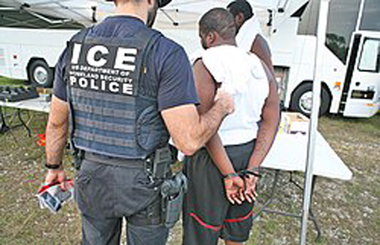
Analysis of 1.6 million ICE arrests finds shifts in enforcement patterns, with more arrests occurring in community gathering places like airports, workplaces and Democratic strongholds.
Just 34% of people arrested by U.S. Immigration and Customs Enforcement agents during President Donald Trump’s second term have a criminal conviction, according to new research published July 27 in the Proceedings of the National Academy of Science.
That percentage is a near-historic low, the authors note.
“Our results reveal that the reality of immigration enforcement diverges sharply from the public narrative that ICE arrests are necessary to protect public safety by removing people who commit crimes,” said lead author Chloe East, an associate professor of economics at the University of Colorado Boulder.
East analyzed 1.6 million ICE arrests from October 2015 to March 2026, looking at the location and method of each and whether the person arrested had a criminal conviction.
They found that early in each of Trump’s terms, his administration delivered on its promise to increase ICE activity.
For example, the daily average number of ICE arrests in the first 14 months of Trump’s first term was 436, up 43% from the daily average during President Barack Obama’s final year in office. In the first 14 months of Trump’s second term, average daily ICE arrests soared to 952 per day, up 214% from President Joe Biden’s final year in office.
Increased enforcement did not, however, translate to more arrests of previously convicted criminals. Instead, the opposite happened.
Just one in three ICE arrests during Trump’s first 14 months in office—for his second term—involved individuals with criminal convictions. That’s down from 52% in Biden’s final year in office, 70% in Trump’s first year of his first term and 79% in Obama’s final year.
“We found that there is an inverse relationship between the number of arrests that ICE makes and ICE’s ability to target people with a criminal conviction,” said East.
The study also identified changes in the way ICE arrests are being conducted, with more arrests now made in community gathering places like schools, workplaces and airports. In the past, ICE typically detained individuals who were already in law enforcement custody.
Before Trump’s second inauguration, only 17% of ICE arrests were made in the community. That has risen to nearly half of all arrests.
Enforcement activity has not taken place evenly across the country.
In 2025 & 2026, Democratic strongholds like Denver, Boston and Washington, D.C., were far more likely to see dramatic spikes in community arrests, the study found.
For instance, in the enforcement area that includes Denver, which has a Democratic mayor and governor, ICE arrests increased 220% at the beginning of Trump’s second term, with community arrests increasing 269%.
Previous studies have consistently shown that immigrants, including undocumented immigrants, are less likely to commit crimes than are people born in the United States.
East fears that by increasingly arresting those with no criminal record, heightened ICE enforcement efforts could make communities less safe by making law-abiding citizens afraid to report crimes.
“Overall, our data provide important new evidence that simply increasing the funding and scale of ICE activity is unlikely to improve public safety.”
By the University of Colorado Boulder for Newswise. The Gayly online. 8/5/26 @ 10:35 a.m. CST.