


A kilt-lifting male romance
- by Jack Chandler
Book Critic
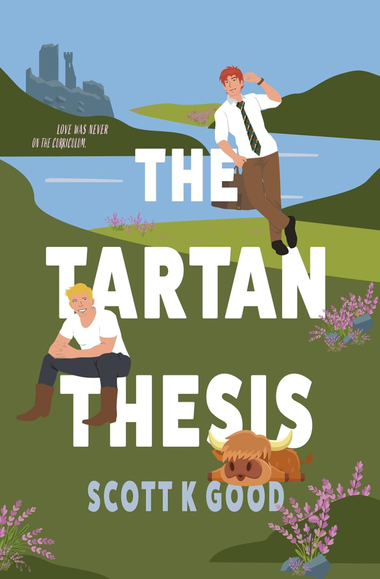
I’m a sucker for a man in a kilt, especially if he’s also playing bagpipes. The Tartan Thesis, by Scott K. Good, is a fun M/M romance—set in Scotland, obviously—that delivers some steamy kilt-lifting. Bagpipes are blown more than once, and, after the inevitable slow burn, there’s a happy ending.
I listened to the audiobook. Kudos to the voice actor with the sexy Scottish accent. Plus, there’s a bonus at the end: a song composed for the book, a cheeky ode to Highland coos (those Scottish cows with bangs and curly eyelashes). I laughed and teared up at that. (In retrospect, overdosing on Benadryl might be partially to blame. The ragweed levels here in Oklahoma City are toxic.)
The Tartan Thesis introduces us to Torin Ramsay and Beau Fontenot, both beginning PhD work at the University of Edinburgh. Cue the book’s witty subtitle: “Love was never on the curriculum.”
Torin is a Scot—red-headed, bookish, and socially awkward. Plus, he’s academically competitive and determined to stay focused on his studies.
Beau is a Texan—blond, beautiful—who, at first glance, seems to embody brawn over brains. He’s had plenty of sex but never a boyfriend.
Both guys are gay, although Torin assumes Beau is straight.
You can take it from there. There’s the genre’s baked-in slow burn: first kiss around page 100, followed by miscues and drama, and first kilt-lifting another 100 pages later.
Here’s what sets the book apart. Each chapter begins with a Scottish or Gaelic word, defines it, explains its common usage, and then works that word into the chapter. Once I clued in, I started listening for those little Easter eggs and was excited when I heard them. A few of my favorites are bawbag, eejit, and dobber.
I identified with introverted Torin but fell in love with Scotland through Beau’s eyes. That’s why the song about Highland coos got to me. Beau had gushed over them as only a Texan can.
At one point, Beau and Torin are in a gym, a new experience for Torin.
“People thought you were gay?” Torin asks, seeming surprised, which is confusing. I tilt my head and watch his clueless expression until it clicks: he doesn’t know.
“Torin,” I say, “I am gay.”
One of the dumbbells slips out of his hand.
I had fun watching these two opposites attract and repel each other. The chapters alternate between Torin’s and Beau’s points of view, which deepened my connection with each of them.
The slow burn seemed forced. Torin and Beau are wildly attracted to each other. They are in the same classes, work out together, travel to historic sites in Scotland—and yet get trapped in their own minds for weeks, sometimes months at a time. That’s believable for Torin. But Beau, who is confident and extroverted? I know about living in one’s head, but I can promise you that if I had hot sex with someone I felt deeply connected to and then things got awkward on his part, I’d corner him after class or a workout and have a chat.
That’s my only complaint. Otherwise, The Tartan Thesis is thoroughly enjoyable. The author’s love of Scotland—its culture and food—is contagious. I want to go there now. I might even try haggis.
The absence of dark themes was a pleasant change of pace. And this is Good’s first novel, which he self-published—a daunting undertaking.
Slàinte mhath, Scott! Keep writing, please.
The Gayly online. 11/23/26 @ 1:31 p.m. CST.