


Bullying: LGBT students remain unprotected
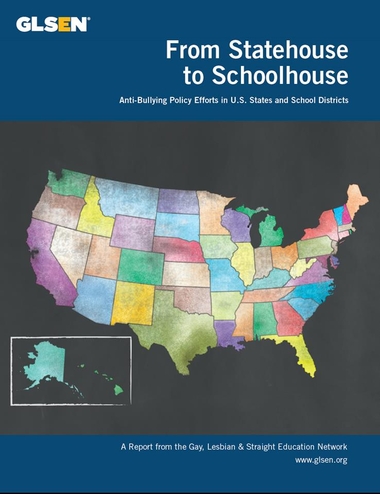
New GLSEN report examines policies of every school district
(New York) GLSEN, the leading national education organization focused on ensuring safe and affirming schools for all students, today released From Statehouse to Schoolhouse: Anti-Bullying Policy Efforts in U.S. States and School Districts, a report that examines anti-bullying policies in all 13,181 school districts across the country, and how state law and guidance affect policies at the district level. The report includes five major findings:
- The vast majority of school districts do not have anti-bullying policies that explicitly protect lesbian, gay, bisexual and transgender (LGBT) students. Only one in 10 districts has a policy that includes explicit protections for students based upon actual or perceived sexual orientation and gender identity/expression. Nearly three in 10 (29.5 percent) have no anti-bullying policy at all.
- Many district policies fail to align with state law. In states with anti-bullying laws, over a quarter (26.3 percent) of districts did not have district anti-bullying policies. In states with anti-bullying laws that explicitly protect students based upon actual or perceived sexual orientation or gender identity/expression, many district policies do not include the same protections (38.7 percent failed to include sexual orientation; 60.3 percent failed to include gender identity/expression).
- LGBT-inclusive district policies have a positive effect on school climate for LGBT youth. LGBT students in districts with LGBT-inclusive policies report greater feelings of safety and lower rates of victimization.
- Only two in 10 school districts require professional development for educators on bullying. Only two in 10 require district accountability for reporting of bullying incidents.
- Law and guidance at the state level strongly influence the presence and content of district policies. Having a state anti-bullying law doubles the likelihood that a district has an anti-bullying policy. If state policy guidance that gives districts a framework for creating its own local policies for schools includes explicit protections for students based upon gender identity/expression, the odds are 10 times greater that a district policy includes those protections. For state guidance that includes sexual orientation, the odds are two times greater that a district will include those protections in its local policy.
“From Statehouse to Schoolhouse reinforces our long-held and proven belief that LGBT-inclusive laws and policies lead to improvements in the experiences of LGBT students,” said GLSEN Executive Director Dr. Eliza Byard. “The report also illustrates the gap that can emerge between the intentions of a law and the actual implementation – arguably the most critical component of the passage of any law. There remain far too many school districts that have failed to institute policy protections, even in states which require them by law. As a result, these schools continue to fail our students.”
Based on the findings in From Statehouse to Schoolhouse, GLSEN has a number of recommendations to better protect all students through anti-bullying policy efforts including:
At the state level, adopt anti-bullying laws that include explicit protections for students based upon actual or perceived sexual orientation and gender identity/expression along with race/ethnicity and other personal characteristics. These laws should also require professional development for educators on bullying and district accountability for incident reporting that specifically include these protected characteristics.
At the district level, ensure districts comply with state laws and adopt anti-bullying policies that include explicit protections.
The full From Statehouse to Schoolhouse report can be found at www.tinyurl.com/pp4lphc.
Anti-bullying policy in The Gayly’s region
Arkansas: Districts with anti-bullying policies – 59.8% / Percentage including LGB – 1.6% / Percentage including LGBT – 0.4%
Kansas: Districts with anti-bullying policies – 59.0% / Percentage including LGB – 2.07% / Percentage including LGBT – 1.7%
Missouri: Districts with anti-bullying policies – 77.1% / Percentage including LGB – 55.6% / Percentage including LGBT – 0.2%
Oklahoma: Districts with anti-bullying policies – 32.6% / Percentage including LGB – 5.6% / Percentage including LGBT – 0.6%
Texas: Districts with anti-bullying policies – 95.0% / Percentage including LGB – 1.1% / Percentage including LGBT – 0.0%
About GLSEN: For 25 years, GLSEN has lead national education organization focused on ensuring safe and affirming schools for all students. GLSEN seeks a world in which every child learns to respect and accept all people, regardless of sexual orientation or gender identity/expression. For information on GLSEN, visit www.glsen.org.
The Gayly – August 15, 2015 @ 12:40pm.