


Gay Carnival – when the whistle blows, grab the first woman you see and start dancing
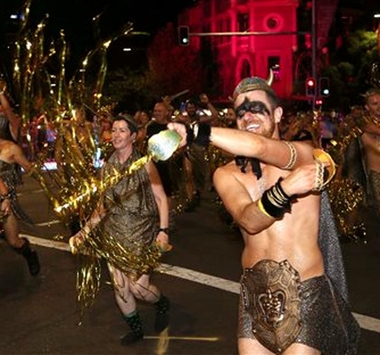
New Orleans (AP) — The joy of being able to create and show off wildly flamboyant Mardi Gras drag when men could be arrested for cross-dressing in public. The raided ball that ended New Orleans' first gay Carnival krewe. AIDS, which wiped out two-thirds of the krewes. Mardi Gras balls on a shoestring, with oodles of flair.
Those are likely topics when a dozen founders of New Orleans' gay and lesbian Carnival krewes — 11 men and a woman — get together Sunday at the Louisiana State Museum for a public discussion about gay Mardi Gras organizations and the experiences of gay Carnival from their start in the 1950s until now.
It's strange to be recognized as part of history, said Mike Moreau, a founding member of the Krewe of Amon-Ra, the city's third gay krewe, queen of last year's 50th anniversary ball, and one of the panelists.
"I don't consider myself as part of history. It's very surreal. It doesn't seem like it's possible," he said Monday.
He was part of the gay Carnival scene when participation was dangerous.
"Every time we went to a Carnival ball or function, we all knew there was a 50-50 chance that we were going to get arrested," said Moreau.
The city's first gay Carnival club, the Krewe of Yuga, was formed in the late 1950s and disbanded after police raided its fifth ball in 1962, said Wayne Phillips, the museum's curator of costumes and textiles and of carnival collections.
Moreau said some of his friends were at that ball and lost jobs because they were named in news reports about the raid.
Phillips said the second group, the Krewe of Petronius, got a state charter as an official Mardi Gras Krewe, as anti-raid protection.
Amon-Ra, formed in 1965, had a raid strategy, Moreau said. He said women — some lesbians, some straight — made up about one-third of the 150 to 200 people at the group's first ball in 1966. Everyone was told that a whistle would be blown if the rented hall was raided, "so grab the first woman you saw and start dancing with her, to hopefully keep from being arrested."
Phillips said gay krewes don't have the money for parades, and have always concentrated on balls, with their costumed tableaux. Many members were professional artists and designers who designed costumes and sets for the show.
"Word got out," he said. "Certainly by the 1970s and 1980s invitations to the gay balls were highly sought after by all segments of society."
Moreau and the other panelists were located by Howard Smith during research that began for a novel and evolved into a lavishly illustrated history book to be published next year by the University Press of Mississippi.
Smith, a history major who is now art director for the library system at the University of Southern California, wanted reference books. There weren't any.
And many memories, he found, were spotty.
"It was fading away. Definitely. Many of the krewes had disbanded because of AIDS. There were probably 12 or 13 in the mid-80s, but only three or four in the mid-90s," he said.
The number of such krewes has grown since: Now there are seven.
Phillips said the research helped the museum acquire photographs, costumes, and many original sketches for costumes and the art from which posters and ball invitations were created.
"Through Howard's research, we have kind of rediscovered the original art work. ... We're able to recover and bring back to light and really give attention to the people responsible for the look of gay Mardi Gras," Phillips said.
By Janet Mc Connaughey, Associated Press. Copyright 2016 The Associated Press. All rights reserved. This material may not be published, broadcast, rewritten or redistributed.