


An ecclesiology of the modern lesbian bar
- by Adèle Marie-Alix
Lesbian Columnist
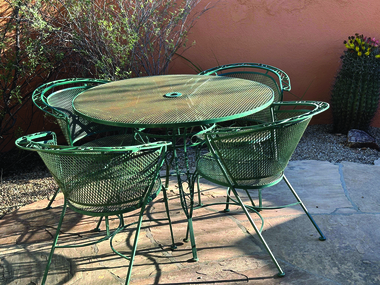
The first time I went to a lesbian bar this year, the patio furniture was absolutely terrible.
Rusted metal tables that wobbled, chairs that complained when you leaned back. The kind of furniture that makes you brutally aware of your body and reminds you that you’re here, you’re physical, you take up space.
Which is to say: perfect for a bar full of lesbians.
Everyone started in small clusters. A polyamorous lesbian with vibrating vibrator earrings, a nonbinary dyke and their soon-to-be wife explaining, with the seriousness of neurosurgeons, the best binding options for someone with my particular chest situation, a trans lesbian with he/him pronouns, on testosterone, wearing a halter top and doused in glitter.
Eventually, someone said something along the lines of, “Wait, why are we sitting like this?” and we started dragging tables and chairs together. Not in any graceful way. Just strangers and friends muttering sorry, hold on, let me squeeze in, thank you.
A blunt got passed around. Yes, mother, I politely declined.
The moment wasn’t profound. That was the spell. It was ordinary. Warm. Awkward.
A single, messy table.
No one paused to classify anyone else into the right conceptual drawer. No one asked for credentials—no one audited pronouns. No one stopped mid-sentence to figure out who counted as what, why, and how.
On the internet, this table would have caused discourse collapse. People would have insisted it was impossible. That someone’s presence invalidated someone else’s identity. That this combination of pronouns and bodies and relationships and experiences could not coexist without contradiction. But the bar didn’t care about contradiction. It didn’t require a thesis statement.
Online, we fight about questions that evaporate the second you are actually in a space full of breathing people.
It is convenient to make the borders of our identities into battlegrounds. Convenient for the people who want us exhausted, isolated, busy proving we belong. Targeting trans people is especially convenient because the state has already done half the work of making them vulnerable. If you can convince lesbians to guard the gate, the gate guards itself.
But the reality is that lesbian history has never had clean lines. Butch identity has long complicated gender. Some of us have moved between pronouns longer than the internet has existed. Many trans men and women were central to the development of lesbian culture and its survival, even when their efforts went entirely unacknowledged. In short, our dyke community has always been a quilt of genderfuckery patchwork.
I am uninterested in the table where everyone conforms.
I want the table where we figure out how to talk to the stranger next to us, the one where conversation overlaps. The one where the measure of belonging is whether you sit down and stay awhile, and where we understand that the world outside is hostile, which means our brief time together on this earth should not be.
If there is a golden rule in the queer community, it is that you do not earn your seat. You just sit.
And then someone looks up and says, “Hey, could you pass me the lighter?”
The Gayly online. 12/21/25 @ 5:31 p.m. CST.