


Superb storytelling in The Safekeep
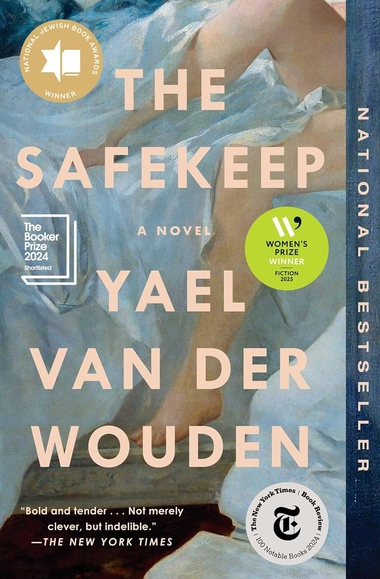
- by Jack Chandler
Entertainment Writer
The Safekeep is a lesbian love story wrapped in historical fiction, tied with a shiny ribbon of mystery. I thoroughly enjoyed unwrapping it.
We’re plopped into the Netherlands in 1961, watching life through the eyes of thirty-two-year-old Isabel. She’s reluctantly having dinner with her two brothers, Hendrik and Louis, and Louis has brought his latest girlfriend, Eva.
Isabel notes Eva’s cheap dress, her fake laugh, and the fact that she doesn’t know what scallops are.
Isabel doesn’t like her brothers either. Hendrik is gay and unapologetic, which disgusts her. Men are meant to be with women. Then again, she also disapproves of Louis’s serial womanizing.
Let’s just say that the sprockets on Isabel’s clock are wound tight. The cuckoo seems poised to spring.
If you’re thinking Isabel isn’t very likable, I totally agree. (I started the book only because hubs insisted I do so, but figured this would be another of his duds. Regular readers of my reviews know that hubs has picked a few winners, but his tastes and mine don’t usually align. Not sure I can ever forgive him for foisting The Overstory or North Woods on me. If you’re keeping count, he’s 50/50: Martyr and now The Safekeep are winners.)
Back to The Safekeep. Isabel lives alone in the family home, preserving it almost as a memorial to their deceased mother. The house came fully furnished when her family moved in, right down to the fine china, and Isabel guards both the house and its routines with near-religious devotion.
This being a love story in which one of the women is glued to her country home, the author needed a way to bring them together. Voilà, Louis has to leave the country on a business trip. He insists that Isabel allow Eva to stay with her in the family home.
On paper, the setup sounds obvious.
In practice, the author has a surprise waiting. I can’t say more without becoming that person who tells you what’s inside the present before you unwrap it.
Isabel does not want a guest, especially not Eva.
Isabel does not believe herself a sexual being—certainly not a lesbian. She was there when Hendrik came out to their mother and has internalized their mother’s disgust for homosexuality.
Slowly, over the month the two women share the home, Isabel’s repressed desires begin to percolate to the surface. There’s a kiss, lots of angst on Isabel’s part, then this:
“The discovery was that Isabel could not keep quiet. She had done as much for all her life, in her bedroom, underwear bunched, corner of a pillow stuffed into her mouth. Not a peep from her, perfunctory and quick. She did not manage as much now. She could not keep quiet. She could not. The sounds pulled from her, loud under the room’s slanted ceiling; loud in the night. Eva’s fingers were slow on her, sliding round where she wanted them—around, around, never quite there.”
There are other, more graphic scenes, but you’ll have to read the book to get those.
And then Isabel finds Eva’s diary, reads something she believes she cannot forgive, and kicks Eva out in disgust.
We see that Eva is not who we thought she was. She has her own story, her own motives. Don’t forget she was dating Louis before he left on his trip.
Here again, the author emerges as a superb storyteller, as if we peel away one layer of wrapping only to discover another beneath it.
There’s a whole other level to this story, one rooted in recent history—a field I admittedly thought had been plowed too often. I was wrong. I’d never heard the historical story from this angle.
Don’t worry. This isn’t a history lesson with a side serving of lesbian love. Instead, it’s primarily a story of two women who just happen to have been shaped by events larger than themselves.
The beauty of this story isn’t that Isabel and Eva get their happily-ever-after. That’s almost expected.
The real beauty is that you grow to care about Isabel and want her to succeed.
I love how she comes out to her brother, Louis, in her understated way, obliquely referencing their gay brother, Hendrik.
Louis has been encouraging her to date more men.
“I will not marry,” said Isabel.
“Isabel, come now, what’s—”
“I will never marry. I’m telling you.”
“Don’t say that,” he said. “You don’t know that.”
“Hendrik,” Isabel said, “will never marry. I will never marry.”
He stopped stirring his coffee. “That’s not the same. You know that’s not the same.”
Isabel said it again. “Louis, I will never marry. Hendrik will never marry, and I will never marry. Do you understand?”
This made me tear up a bit. We live in an age where—at least for now—we have the right to marry. We live in an age where coming out involves the proclamation that we’re gay. We talk about Pride.
In 1961, in the Netherlands specifically and really worldwide, those were foreign concepts. I wanted to cheer for Isabel for having found the courage to speak even these words.
You’ll cheer, too, once you read the book and understand its secrets.
The Gayly online. 7/16/26 @ 6:53 p.m. CST.