


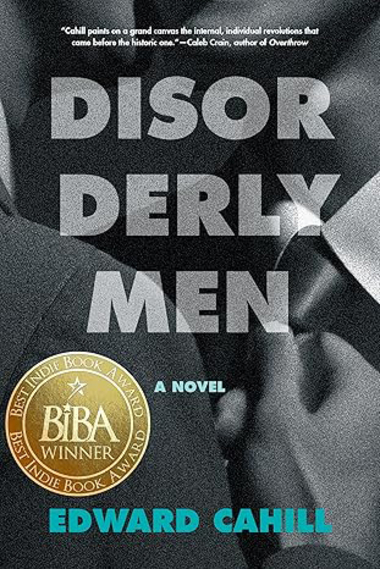
"Disorderly Men"
- by Jack Chandler
Entertainment Writer
Police raid a Greenwich Village gay bar, swinging batons and cursing. Thirty men are shoved into a paddy wagon. A young hustler in a fake fur coat takes charge.
“Listen up, ladies,” he says, then tells them what to expect: fingerprinting, mug shots, a fine, and their names in tomorrow’s papers.
This is how Edward Cahill’s Disorderly Men begins, in pre-Stonewall New York.
One of these men is Roger Morehouse—married, father of two, vice president of a prominent bank, and deeply closeted. Only minutes earlier, he’d been sharing a drink with a handsome young man named Andy. Now he stands to lose everything: his wife, his kids, his job.
As the reality of his situation sinks in, Roger imagines the collapse of everything he has so carefully constructed.
“Fragments of his very good life—the fancy new office overlooking lower Broadway, the house in Beechmont Woods, Corrine and the children—all presented themselves to his imagination as fitting sacrifices to the selfish pursuit of pleasure.”
Another man in the wagon is Julian Prince. Cahill pauses the action and rewinds the scene to the moments just before the raid.
“A bough of dusty mistletoe hung over the entrance to the toilet, near which Julian Prince hashed out an argument with his latest boyfriend, Gus, who was the most appealing man he’d ever met but now upset for reasons entirely beyond Julian’s control. To make matters worse, a stream of patrons passing to and fro were bearing indelicate witness to their private contretemps.”
Disorderly Men—a title that nods both to the legal charge of “disorderly conduct” and to the slow unspooling of these men’s lives—is Cahill’s daring debut, told through three distinct viewpoints: Roger, Julian, and the lovable Danny Duffy. More on Danny in a moment.
Let me borrow a trick from Cahill and pause the review for a moment. Readers come to gay literature looking for different things. If you want sex and romance, pick up Red Flags and Tuesdays—that’s your Wild Turkey kind of read. If serious queer history is more your speed, try The Sins of Jack Saul, which goes down like a good Woodford Reserve. But if you crave literary fiction—the kind of writing that skips the cheap thrills and lingers instead over deeper notes of flavor—Disorderly Men is the eighteen-year-old single malt. It will seduce you and slap you all at once.
Danny Duffy is my favorite of the three men. He’s blue-collar and hails from a large Irish Catholic family. Hell, he’s got so many brothers I had to flip back a few pages just to track which of them was the meanest. A coin toss, honestly.
Danny’s the youngest and smallest of the lot. He wears his jeans a little too tight, and he likes Doris Day. The reason he was in that gay bar on the night of the raid? Drowning his sorrows because his brothers ganged up on him at a family dinner and pressured their mother to kick him out of the house.
“Over breaded cutlets in their Parkchester two-bedroom, Danny had been accused, judged, and banished in short order. What began as a snide remark from his second-eldest brother, Quinn, soon turned into speculations about Danny’s inexperience with women. Their mother, Margaret Duffy, who’d been drowsing over her plate, perked up when she heard the word ‘virgin’ and glared at no one in particular.”
What distinguishes this story is that these characters don’t sit back and accept their fate as the biblical Job did. It takes them a while to find their courage, but when they do, you’ll want to toast them with that single malt.
In the process, Disorderly Men reminds us how far we’ve come—and why the courage of those who came before us is worth raising a glass to.
The Gayly online. 4/19/26 @ 6:08 p.m. CST.